Nye's analysis of public diplomacy and the use of soft power to increase globalization reflects a need for nation-states to re-assess the way they communicate with the world. He calls for a bigger focus on daily communication, strategic communication, and creating lasting relationships --all in an effort to project a consistent message to foreign audiences and in turn provoke dialogue between these audiences and the United States.
He notes that actions, not just broadcasting are an effective means of reaching out to others in order to create such relationships. Through student exchange programs and English language teaching opportunities, citizens of different countries have the chance to make close bonds which they then continue via the Internet or other means upon separation back to their home countries. This is an example of everyday people serving as ambassadors, and is definitely a useful form of public diplomacy. JET, the Japan Exchange and Teaching programme is a successful example of this effect. Just take a look at their website and you will see a variety of pictures of Americans and Japanese students -happy and having fun. I have a friend who worked with JET as a teacher, and after one 6 month period with the program he decided to stay longer and continue working with JET to this day... that was 2 years ago. He has made so many friends in Japan with people of many different cultural backgrounds, and when he visits the United States he also serves as a bridge of Japanese knowledge to those Americans who have not been to that country.
Nowadays it seems that public diplomacy may be most affective from this approach of people getting to know people. Governments appear to be inconsistent and complex; therefore, everything 'produced' as public diplomacy to be broadcast to the world is automatically stamped as propaganda related in nature. But if a bottom-up approach is implicated, there will be more exchange programs and more opportunities for citizens to branch out and embrace different cultures and peoples. This will in turn enable them to broaden their views on foreign audiences and serve as a mouthpiece for their countries of origin. The future of public diplomacy is dependent on the genuine relationships which are most easily created by everyday people with genuine interests in other cultures; it would appeared that the role of illegitimized governments in the realm of public diplomacy is shrinking and becoming less and less effective.
Sources:
Nye, Joseph "Public Diplomacy and Soft Power"
http://www.jetprogramme.org/
Thursday, November 18, 2010

Monday, November 15, 2010
Framing and Decontextualization in Wikileaks’ “Collateral Murder”
Though the articles we read for this week focus more on mass media, new media such as Wikileaks can be analyzed using the same concepts of framing and decontextualization.
On April 5th, 2010, Wikileaks released a video called “Collateral Murder,” described as follows:
“Wikileaks has obtained and decrypted this previously unreleased video footage from a US Apache helicopter in 2007. It shows Reuters journalist Namir Noor-Eldeen, driver Saeed Chmagh, and several others as the Apache shoots and kills them in a public square in Eastern Baghdad. They are apparently assumed to be insurgents. After the initial shooting, an unarmed group of adults and children in a minivan arrives on the scene and attempts to transport the wounded. They are fired upon as well. The official statement on this incident initially listed all adults as insurgents and claimed the US military did not know how the deaths ocurred [sic]. Wikileaks released this video with transcripts and a package of supporting documents on April 5th 2010 on http://collateralmurder.com”
In an interview with Julian Assange, founder and editor of Wikileaks, Stephen Colbert says: “You have edited this tape… and you have given it a title… called ‘Collateral Murder.’ That’s not leaking, that’s a pure editorial.” Assange responds: “The promise we make to our sources is that not only will we defend them, through every means that we have available… technological and legally and politically… but we will try and get the maximum possible political impact for the material.” However, he mentions that the site also released the full, unedited version to the public so that people of a differing opinion may analyze it themselves.
But Colbert others have pointed out that the edited version was much more heavily publicized. In fact (as of 11-15-10, 7:30 pm), the edited version had 7,594,756 views on You Tube, while the full 39-minute version had 1,187,767 views. Beyond that, one must also consider the millions of people that only saw clips of the video in television news reports, further decontextualizing the event. Furthermore, how many people have actually consulted the “package of supporting documents” on Wikileaks’ website? [I admit that I myself have not viewed the full version nor read any of the supporting information.]
Interestingly, the full video is posted with the following disclaimer: “Please note: This is a full uncut version of the video primarily intended for research purposes. See [the edited video] for a short and concise version with added context” (emphasis added). The “added context” refers to the subtitles and commentary that are provided to both situate and frame the event for “maximum political impact.” Clearly Wikileaks has an agenda, and the video fails to provide information about what happened directly before the attack, let alone the “political, economic, social and cultural relations of cause-and-effect” (Hafez, “International Reporting,” 35). For example, what might have occurred before the attack that lead the soldiers to perceive the minivan as a threat? The official U.S. military investigation reports that there was a black vehicle in the area that had been dropping off and picking up insurgents. Whatever the entire truth is, it is clear that Wikileaks is framing the tragic event in a way that supports the organization’s idea of “maximum political impact.”
Could “Collateral Murder” be considered an example of what el-Nawawy and Iskandar (2003) refer to as “contextual objectivity” in which the media present stories in a way that is “somewhat impartial yet sensitive to local sensibilities”? “Contextual objectivity” is an “audience-centered bias” where “all media deviate from the standard of objectivity by framing the facts of a given situation in ways that are socially accepted and expected amongst particular audiences” (Powers and el-Nawawy, 268). Yet Wikileaks, as an organization and not a mass media outlet, is not obligated to cater to its audience. However, it does frame its information to promote its agenda and gain the support of the public, which has the potential to influence politics.
Powers and el-Nawawy (2009) discuss how viewers choose to consume news that affirms their opinions rather than informs, and how news media tends to reinforce existing worldviews. As Hafez puts it, “the media follow rather than lead” (54). In the case of Wikileaks, a strict anti-war audience might be more likely to view the video as-is, as it affirms their opinions and provides supporting evidence. Others, whether supportive of the war or U.S. government policy in general, might consider the information untrustworthy and completely dismiss the video without considering the questions it raises. And low-dogmatic individuals (Davies, in Powers and el-Nawawy, 275) might be more likely to question the footage, perhaps reading the supporting documents or finding additional sources if the information presented conflicts with their opinions, as “the open nature of their cognitive systems allows them to see connections between belief and disbelief systems.”
References:
Powers, Shawn and Mohammed el-Nawawy. “Al-Jazeera English and global news networks: clash of civilizations or cross-cultural dialogue?,” in Media, War & Conflict 2009 2: 263-284.
Hafez, Kai. “International Reporting,” in The Myth of Media Globalization. 24-55.
Friday, November 12, 2010
Decontextualization: A Neverending Cycle?
In Hafez' article, "International Reporting," he takes a critical view as to the real effects of international reporting and does not see it as a globalizing factor. He criticizes international reporting by discussing the idea of decontextualization and the idea that it is a result of media consumers' limited knowledge of foreign settings. This immediately reminded me of the case of the capsizing boat in Orissa as described by Chouliarki in her article, "Symbolic Power of Transnational Media," in which she discussed the difference between extraordinary news and ordinary news and the factors that decide how the media will portray events of suffering. In the case of the capsized boat, the media had a short segment on the event, dehumanizing it all, only showing a red dot on a map as the story was told. The media is assuming (and probably rightly so) that its consumers do not have a clue where the Orissa province of India is, making it less important, and making a map necessary. They choose not to make this news event a teachable moment to talk more about the province -it's history or significance, because they assume that the consumer probably does not care. Because the consumer probably does not care, they are satisfied with simply throwing a red dot on a map and quickly telling the story which leaves the consumers no more interested or worried about the region than they were before the broadcast.
Note how this cycle of decontextualization does nothing to increase consumer knowledge or concern, nor does it do anything to affect social movement or aid for the situation at hand. Is this cycle the fault of the media or the fault of consumers? If the media assumes that a story is of no interest to its consumers then why would they report any more on it than they feel they have to? Perhaps the media should take it upon themselves to find more ways to connect these types of stories with its audience. If consumers are only really attracted to cases of suffering that affect people like themselves, then the media could at least use that knowledge to make the effort to report these stories in such a way so that consumers can understand how the suffering of these people could somewhat affect them. The media could also put more effort into making such stories more personal, showing the suffering of the people and devastation even though they may be 'the other.' Upon reading studies of the affects of international news and reporting, it is very apparent that biases and ratings cloud and hinder these forms of media from being a truly globalizing force.
Source:
Chouliarki, Lilie "The symbolic power of transnational media: Managing the visibility of suffering"
Hafez, Kai "International Reporting"
Note how this cycle of decontextualization does nothing to increase consumer knowledge or concern, nor does it do anything to affect social movement or aid for the situation at hand. Is this cycle the fault of the media or the fault of consumers? If the media assumes that a story is of no interest to its consumers then why would they report any more on it than they feel they have to? Perhaps the media should take it upon themselves to find more ways to connect these types of stories with its audience. If consumers are only really attracted to cases of suffering that affect people like themselves, then the media could at least use that knowledge to make the effort to report these stories in such a way so that consumers can understand how the suffering of these people could somewhat affect them. The media could also put more effort into making such stories more personal, showing the suffering of the people and devastation even though they may be 'the other.' Upon reading studies of the affects of international news and reporting, it is very apparent that biases and ratings cloud and hinder these forms of media from being a truly globalizing force.
Source:
Chouliarki, Lilie "The symbolic power of transnational media: Managing the visibility of suffering"
Hafez, Kai "International Reporting"
International Broadcasting & The Inverted Pyramid
We know that international reporting is important. Not just how much but the quality of the reporting as well. According to Powers and el-Nawawy, the manner of international reporting has the potential “to make international conflicts more difficult to resolve.”(el-Nawawy 2009) This, instead of what could be the ultimate potential of international reporting, which they describe as: “The global news media fostering engagement and understanding between geographically distant and culturally diverse publics.”
How much does this gap between the potential of international reporting and its current reality have to do with how we are training journalists? Writers and reporters rely on the Inverted Pyramid style of writing for newspaper and broadcast, especially in the hard news style. This format top loads the pertinent information so that copy editors can cut paragraphs from the bottom up of the story if the space or time requires it. The who, what, when, where, and why are shoved into the leading paragraph and supporting or flushed out in the second and third paragraphs. The rest is there for support.
So where is the room for contextual background in this format? There’s not, typically. As humans, and throughout most people’s education, the narrative format is the style in which we are used to being introduced to new information. “Once upon a time, in a kingdom far, far away…” We’re used to the set up first. The background information before we get to the main plot. That’s how we are used to getting drawn into a story.
Thus is the Inverted Pyramid actually hurting international reporting? Are journalists are missing out on the teachable moments because of the style in which they are trained? Particularly on more esoteric topics like international politics or economics, where perhaps national audiences are less familiar with the subject, would a little background information first allow international reporting to grow its audience? Does a story with no context lose its potential audience right away because they have been given no set up? Do national audiences tune out because they have been given no way to relate the story to their own lives or given new information in a narrative format with which they are familiar?
If so, the problem in international reporting has an attainable solution. Change the way journalists are trained. They are all good writers. Give them the room to write tell the whole story.
Sources:
Monday, November 8, 2010
The Space for Humanizing in New Global Justice Networks/New Media?
One of the more moving speeches at this week’s conference on Public Diplomacy was Dr. J.P. Singh’s talk on Humanization in Public Diplomacy. It’s not a completely new topic for our International Communications class, particularly in Chouliaraki’s article on how the media and news present suffering. However, his historical perspective was very helpful in putting the concept in context.
In history, much of the areas of the world that are now the focus of public diplomacy and often development projects were once areas of empires and colonization. As Singh put it, there were basically two approaches: 1. Are they just savages? 2. Can we make them like us with education? Today’s modern diplomats and militaries are faced with an uncomfortably close version of these questions. He put it in terms of armies: are we able to fight a war if we humanize the other side? The reverse is: must we humanize the other side in order to stop fighting wars?
But are there new possibilities in modern communications that change the ground rules? Tweets are not the answer, in Singh’s opinion. And as Dr. Nicolas Cull put it, Tweeting by diplomats where a country only has followers but doesn’t follow any cultural shapers in other countries is damaging to public diplomacy in fact. But I would argue that new media can change the ground rules in that it puts the tools of media technologies in the hands of so many more users.
This trend of media participation, in which everyday citizens have a much lower cost to publish and disseminate ideas and information—make their own voices heard—in other parts of the world, and to other cultural audiences, is what is new today, as both Castells and Bennett point out. To me, this is the space for humanization. The Pandovi article was a great example. In L’Arcilla, by using and taking advantage of new media, the citizens were able to put a real face to the situation post-earthquake.
Citizen advocacy networks are becoming powerful channels for social change because with a camera, or a flip video clip, or a cell phone, images and video can be shared all over the globe in seconds that add a human face to any policy issue. The key to change, especially in the realm of global justice where we have to reach beyond our immediate communities, is deeply rooted—depends on really—the ability to humanize and to see ourselves in others.
I think that when we try to define and redefine what exactly Pubic Diplomacy 2.0 is, our actions need to always seek what humanizes. Humanization is both our starting point and our litmus test. Anything else is just more noise.
Sunday, November 7, 2010
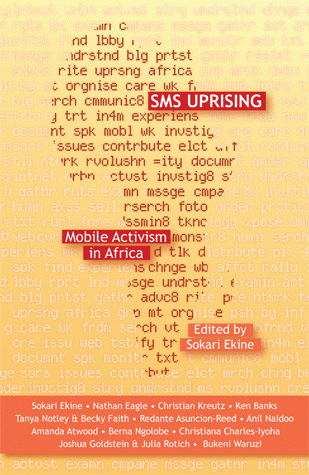
SMS Uprising: Mobile Activism in Africa (Sokari Ekine)
SMS Uprising: Mobile Activism in Africa, edited by Nigerian activist Sokari Ekine, is a collection of essays and case studies involving the use of text messaging to promote social change in Africa. Topics include using cell phones as a means of sharing news and avoiding government propaganda in Zimbabwe and collecting information on children’s rights violations in the Democratic Republic of the Congo; other cases address health communication or alerts about political unrest. Ushahidi in Kenya is also discussed. (Ushahidi is an open-source software that collects and maps SMS data in times of crisis. It was also used by Tufts University to help identify victims and distribute aid in the aftermath of the earthquake in Haiti.)
Sokari Ekine points out that the book is unique “in giving an insight into how activists and social change advocates are addressing Africa’s many challenges from within, and how they are using mobile telephone technology to facilitate these changes...The intention is that the information contained within the book will lead to greater reflection about the real potential and limitations of mobile technology.” In one of the chapters, Anil Naidoo writes that SMS “might at best be used as a complement to social organizing rather than as the central part.”
I’d be interested in reading SMS Uprising, particularly considering the popularity of mobile phones in Africa. While this book seems to illustrate some of what we discussed last class, it also adds another perspective, as the course readings seem to address the use of wireless communication in other regions.
Castells explains that one of the limitations of mobile technology is that “the relative autonomy of the content and process of communication does not necessarily lead to social change” (209). But SMS can facilitate social gatherings and protests as “flash mobilizations” arise from rapid information sharing. Mobility, spontaneity, person-to-person contact, and multi-modality are key aspects of mobile technology that facilitate social activism. The person-to-person nature of SMS lends a sense of trust and credibility. These protests can sometimes yield concrete results, such as the ousting of President Estrada in the Phillipines in 2004. Another example of how mobile activism can affect political outcomes is the case of Korean President Moo-Hyun, voted into office in 2002.
We also discussed in class how the use of mobile technology in activist movements must be seen in the broader context of the movement, including the effects of other communication forms that may be present. Castells illustrates that “wireless communication does not replace but adds to, and even changes, the media ecology, expanding the information networks available to individuals and social groups to emphasize the interpersonal level and to enhance the efficacy of autonomous communication oriented toward political change” (213). Yet he cautions against technological determinism, reminding us that mobile technology does not necessarily result in political activism, and political activism can occur without the use of text messaging.
References:
Castells, Manuel et al. “The Mobile Civil Society,” in Mobile Communication and Society: A Global Perspective, 185-213. MIT Press, 2007.
Friday, November 5, 2010
Stopping Crime, One Mobile Phone at a Time
Castell's explored the way ICT's can affect social and political movements around the world in the article, "The Mobile Civil Society: Social Movements, Political Power, and Communication Networks." I had read about how populations had ousted presidents and reversed elections using the power of networks and mobile technology; and it made me think about the power of mobile technology and how it is used to make changes everyday. I live in Chevy Chase, and when I drive into Bethesda I always see this big digital sign along the street that flashes the following message: "Report Suspicious Behavior," "Dial 1-800-492-TIPS," "Prevention is in Your Hands." The first time I drove by it, I quizzed myself and realized I didn't remember what the phone number was at all and wondered how many people the sign could really affect. After the second and third drive by the sign, I had it memorized, and in fact my brain was programmed to start thinking about types of suspicious behavior I may need to look out for before I even saw the sign and had just turned onto the street. I realized that I now knew the phone number, and that I remembered what the sign said. And for some strange reason, it always made me want to pick up my phone as if just because I saw the sign, I was going to be the witness to some crazy terrorist act or show of violence within the next ten minutes.
I began to relate this to the readings. First of all it is interesting how Maryland has realized the power of mobile technology and uses it in a manner like this to appeal for information that may lead to safer lives for the particular community. I wonder what the statistics are for phone calls received, and how many of them actually lead to the prevention of some situation. Do people just drive by the sign and never think about it again, or does the number get stuck in their heads like it did with me? There are many people who do not like to 'snitch'... they think that everyone should just mind their own business. But it's interesting how the wording of the sign makes it seem like,'hey, this is your civil responsibility to protect yourself and those around you.'Making a difference in society, one mobile phone at a time.
I began to relate this to the readings. First of all it is interesting how Maryland has realized the power of mobile technology and uses it in a manner like this to appeal for information that may lead to safer lives for the particular community. I wonder what the statistics are for phone calls received, and how many of them actually lead to the prevention of some situation. Do people just drive by the sign and never think about it again, or does the number get stuck in their heads like it did with me? There are many people who do not like to 'snitch'... they think that everyone should just mind their own business. But it's interesting how the wording of the sign makes it seem like,'hey, this is your civil responsibility to protect yourself and those around you.'Making a difference in society, one mobile phone at a time.
Subscribe to:
Posts (Atom)