Monday, November 8, 2010

The Space for Humanizing in New Global Justice Networks/New Media?

One of the more moving speeches at this week’s conference on Public Diplomacy was Dr. J.P. Singh’s talk on Humanization in Public Diplomacy. It’s not a completely new topic for our International Communications class, particularly in Chouliaraki’s article on how the media and news present suffering. However, his historical perspective was very helpful in putting the concept in context.

In history, much of the areas of the world that are now the focus of public diplomacy and often development projects were once areas of empires and colonization. As Singh put it, there were basically two approaches: 1. Are they just savages? 2. Can we make them like us with education? Today’s modern diplomats and militaries are faced with an uncomfortably close version of these questions. He put it in terms of armies: are we able to fight a war if we humanize the other side? The reverse is: must we humanize the other side in order to stop fighting wars?

But are there new possibilities in modern communications that change the ground rules? Tweets are not the answer, in Singh’s opinion. And as Dr. Nicolas Cull put it, Tweeting by diplomats where a country only has followers but doesn’t follow any cultural shapers in other countries is damaging to public diplomacy in fact. But I would argue that new media can change the ground rules in that it puts the tools of media technologies in the hands of so many more users.

This trend of media participation, in which everyday citizens have a much lower cost to publish and disseminate ideas and information—make their own voices heard—in other parts of the world, and to other cultural audiences, is what is new today, as both Castells and Bennett point out. To me, this is the space for humanization. The Pandovi article was a great example. In L’Arcilla, by using and taking advantage of new media, the citizens were able to put a real face to the situation post-earthquake.

Citizen advocacy networks are becoming powerful channels for social change because with a camera, or a flip video clip, or a cell phone, images and video can be shared all over the globe in seconds that add a human face to any policy issue. The key to change, especially in the realm of global justice where we have to reach beyond our immediate communities, is deeply rooted—depends on really—the ability to humanize and to see ourselves in others.

I think that when we try to define and redefine what exactly Pubic Diplomacy 2.0 is, our actions need to always seek what humanizes. Humanization is both our starting point and our litmus test. Anything else is just more noise.

Sunday, November 7, 2010

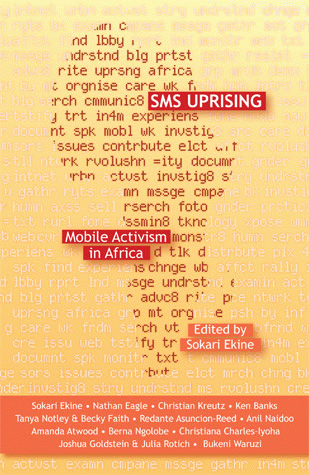
SMS Uprising: Mobile Activism in Africa (Sokari Ekine)


SMS Uprising: Mobile Activism in Africa, edited by Nigerian activist Sokari Ekine, is a collection of essays and case studies involving the use of text messaging to promote social change in Africa. Topics include using cell phones as a means of sharing news and avoiding government propaganda in Zimbabwe and collecting information on children’s rights violations in the Democratic Republic of the Congo; other cases address health communication or alerts about political unrest. Ushahidi in Kenya is also discussed. (Ushahidi is an open-source software that collects and maps SMS data in times of crisis. It was also used by Tufts University to help identify victims and distribute aid in the aftermath of the earthquake in Haiti.)

Sokari Ekine points out that the book is unique “in giving an insight into how activists and social change advocates are addressing Africa’s many challenges from within, and how they are using mobile telephone technology to facilitate these changes...The intention is that the information contained within the book will lead to greater reflection about the real potential and limitations of mobile technology.” In one of the chapters, Anil Naidoo writes that SMS “might at best be used as a complement to social organizing rather than as the central part.”

I’d be interested in reading SMS Uprising, particularly considering the popularity of mobile phones in Africa. While this book seems to illustrate some of what we discussed last class, it also adds another perspective, as the course readings seem to address the use of wireless communication in other regions.


Castells explains that one of the limitations of mobile technology is that “the relative autonomy of the content and process of communication does not necessarily lead to social change” (209). But SMS can facilitate social gatherings and protests as “flash mobilizations” arise from rapid information sharing. Mobility, spontaneity, person-to-person contact, and multi-modality are key aspects of mobile technology that facilitate social activism. The person-to-person nature of SMS lends a sense of trust and credibility. These protests can sometimes yield concrete results, such as the ousting of President Estrada in the Phillipines in 2004. Another example of how mobile activism can affect political outcomes is the case of Korean President Moo-Hyun, voted into office in 2002.

We also discussed in class how the use of mobile technology in activist movements must be seen in the broader context of the movement, including the effects of other communication forms that may be present. Castells illustrates that “wireless communication does not replace but adds to, and even changes, the media ecology, expanding the information networks available to individuals and social groups to emphasize the interpersonal level and to enhance the efficacy of autonomous communication oriented toward political change” (213). Yet he cautions against technological determinism, reminding us that mobile technology does not necessarily result in political activism, and political activism can occur without the use of text messaging.

References:


Castells, Manuel et al. “The Mobile Civil Society,” in Mobile Communication and Society: A Global Perspective, 185-213. MIT Press, 2007.

Friday, November 5, 2010

Stopping Crime, One Mobile Phone at a Time

Castell's explored the way ICT's can affect social and political movements around the world in the article, "The Mobile Civil Society: Social Movements, Political Power, and Communication Networks." I had read about how populations had ousted presidents and reversed elections using the power of networks and mobile technology; and it made me think about the power of mobile technology and how it is used to make changes everyday. I live in Chevy Chase, and when I drive into Bethesda I always see this big digital sign along the street that flashes the following message: "Report Suspicious Behavior," "Dial 1-800-492-TIPS," "Prevention is in Your Hands." The first time I drove by it, I quizzed myself and realized I didn't remember what the phone number was at all and wondered how many people the sign could really affect. After the second and third drive by the sign, I had it memorized, and in fact my brain was programmed to start thinking about types of suspicious behavior I may need to look out for before I even saw the sign and had just turned onto the street. I realized that I now knew the phone number, and that I remembered what the sign said. And for some strange reason, it always made me want to pick up my phone as if just because I saw the sign, I was going to be the witness to some crazy terrorist act or show of violence within the next ten minutes.

I began to relate this to the readings. First of all it is interesting how Maryland has realized the power of mobile technology and uses it in a manner like this to appeal for information that may lead to safer lives for the particular community. I wonder what the statistics are for phone calls received, and how many of them actually lead to the prevention of some situation. Do people just drive by the sign and never think about it again, or does the number get stuck in their heads like it did with me? There are many people who do not like to 'snitch'... they think that everyone should just mind their own business. But it's interesting how the wording of the sign makes it seem like,'hey, this is your civil responsibility to protect yourself and those around you.'Making a difference in society, one mobile phone at a time.

Friday, October 29, 2010

Information Sovereignty and the Case of WikiLeaks

This week’s topic was “Networks and Politics: Influence of Power.” In Sangeet Kumar’s article, he argues that “new media entities such as Google represent a new modality of power, increasingly making inroads into the Westphalian nation-state system” (154). Google’s ‘centerless,’ ‘distributed network’ is difficult for states to challenge or regulate, as illustrated by Google Earth. Several states have tried to fight the company, believing that the availability of satellite images pose threats to security and territorial integrity. Google’s conflict with the Indian government is perhaps the most pronounced example, as the case continued for over a year. (The state could only make requests and threats, though it had no power to enforce them. This problem was only resolved when Google finally ceded in order to ease a business deal.)


Kumar claims that “as they effortlessly transgress boundaries and bypass traditional controls of information flow, digital media institutions such as Google constrain the nation state in unprecedented ways” (155). The company uses its network power to claim that it is advocating for the global free flow of information, which in the public interest.


Julian Assange, spokesperson and editor-in-chief of WikiLeaks, has similarly argued for the freedom of information. The organization has released thousands of classified U.S. military documents from the wars in Afghanistan and Iraq. Like Google Earth, WikiLeaks presents a problem of information sovereignty and national security.

Sen. John Ensign of Nevada has announced a bill to change the wording of the Espionage Act (1917) that would make it illegal to identify informants working with the U.S. military. (Names of informants were included in the Afghanistan documents, and though they have been removed from the Iraq documents, it is still possible to contextually identify them.) The bill is intended to target Assange, though critics say he would be difficult to prosecute, as he is not an American citizen and has no plans to visit the U.S.

It seems that the United States has very little legal power to challenge Julian Assange. However, PFC Manning, the soldier accused of leaking the documents, has been charged with crimes including violations of the Espionage Act.

Recently, some have suggested that the U.S. government launch cyberattacks against WikiLeaks, though the website has done much to protect itself, spreading out its servers, encrypting data, and creating mirror sites. In the past couple days, the organization has ceased hosting documents on Amazon.com servers in San Jose. 

Kumar, Sangeet. “Google Earth and the nation state: Sovereignty in the age of new media,” Global Media and Communication 2010 6:154.

Noopolitik and 21st Century Statecraft?

Ronfeldt and Arquilla present in their article “The Promise of Noopolitik” the articulation of a new, and I argue distinct, concept not just in the field of communications but one that is positioned to oppose the approach of realpolitik in International Relations studies. To what extent is their concept of the noosphere emerging as a reality in the world of today’s statecraft and 21st century public diplomacy? What would a post-post script to their article include today, particularly if they were to address Sec. of State Clinton’s speech at the opening ceremony to the Newseum in Washington, D.C. on January 21st of this year?

Their first claim is that in the latter half of the 20th century, there were revolutions in the business affairs and in military affairs. They argue that the time has come for a “revolution in diplomatic affairs” or a RDA. This will depend on the recognition of the importance of the noosphere. The noosphere is similar to more widely-used concepts like “cybersphere” and “infosphere.” They present several definitions for the term. The first, that of the man who coined it, Pierre Teilhard de Chardin, was that the world evolved in several stages: the first was a geophere, then a biosphere, and the next will be a noosphere—“a globe-circling realm of the mind…full of fibers and networsk, and a planetary ‘consciousness.’” (Ronfeldt & Arquilla 1999/2007 ) Tielhard claimed, “Fully realized, the noosphere will raise mankind to a high, new evoulutionaryplane, one driven by a collective devotion to moral and juridical principales.” ( )

The noosphere is similar to other network theories of communications, but better, in their opinion. The term encompasses information-processing and information-structuring. It looks at not just how messages and ideas are transmitted but also why they are transmitted and how those ideas fit into the larger goals and values of an organization or system. But is this noosphere becoming more important than other concepts in international relations? Are ideas, and where and how effectively they are dissmentated, the new source of power in the world today? One could answer yes, as again and again, civil society (and not so civil non-state actors) are starting to influence and compromise the nation-states options diplomatically.

Rondfeldt and Arquilla are at their strongest in the postscript’s section on American public diplomacy. Writing at the height of the Bush-era crisis of legitimacy for American foreign policy, they sum up their argument in one sentence: “The point to which we keep returning is that noöpolitik is ultimately about whose story wins.” Obviously, America’s story is now competing with Al Qaeda’s in the global public sphere.

They argued that at the time the post-script was written, public diplomacy in this country had gone off track and looked more like realpolitik than noopolitik. But what about the approach of the U.S. State Department today? First, we should look to Sec. Clinton’s address to the attendants at the opening of the Newseum at the beginning of this year. (link to full text below) I believe that the title of the address itself, “Remarks on Internet Freedom” suggest that the State Department has started to shift its focus.

After her introduction, Clinton gets to the subject of her address with the following statement: “The spread of information networks is forming a new nervous system for our planet.” Later, she paraphrased President Obama, saying “he defended the right of people to freely access information, and said that the more freely information flows, the stronger societies become.” She introduced the idea of 21st century statecraft that would call on the State Department to take advantage of these sort of means of diplomacy, that this was a time when a shift was necessary. She stated, “Realigning our policies and our priorities will not be easy.” (Clinton 2010)

So it would seem, at least in theory, the State Department today is shifting toward an acceptance of the importance of ideas in the marketplace of international civil society today. Whether this will help begin a revolution toward a complete noosphere is still yet to be seen, but at least this trend does suggest noopolitik may be starting to win out over realpolitik.

Sources:

Clinton, Secretary of State Hillary. 2010. "Remarks on Internet Freedom." http://www.state.gov/secretary/rm/2010/01/135519.htm (November 3, 2010 2010).

David Ronfeldt & John Arquilla “The Promise of Noopolitik” First
Monday 12 n. 8-6 (1999/2007).
http://firstmonday.org/htbin/cgiwrap/bin/ojs/index.php/fm/article/view/1971/1846


No Westerners Involved?? ... Make it Ordinary News

In the article, "The Symbolic Power of Transnational Media: Managing the Visibility of Suffering," Chouliaraki discusses two types of news coverage: ordinary and extraordinary. Ordinary news is when the station does not make human or emotional connections with the disaster that has occurred. An example of this is coverage on a capsized boat in India in which the only thing shown was a map with a dot giving the location of the boat. Extraordinary news shows rolling footage of the disaster, reporters are on the scene, and people are shown suffering and in need of assistance. An example of this type of news is the 2004 tsunami that hit southeast Asia.

After reading about this analysis of the coverage of suffering, the main concept that surprised me was her idea that the Western population only cares about news that relates to people 'like us.' My first response was, yeah right, there's no way that we only make the suffering of others extraordinary if Westerners are related or the the ones doing the suffering. Yet for every case I could think of, this was true. And if the news and infotainment is showing us what we want to see, then it is a personal reflection of what we care about. I guess we're not quite at the level of 'global consciousness' that we thought, if we do not even care about the suffering of people around the world.

Thursday, October 28, 2010

Global Standards and Online Social Networking

            According to David Grewal, globalization presents a problem of social coordination, how people will meet up and engage with one another. He argues that the world is not “flat” (as Thomas Friedman claims) but “networked.”
Grewal defines standards as “a common way of doing something, a convention that allows us to cooperate, whether we are talking about languages or measurement systems or technical protocols or technology platforms.” Examples of standards in an international network include English or Microsoft Word. The more widely a standard is used, the more valuable it becomes to adopt it in order to communicate. And once it is established, it also has more of a staying power. Though these standards are non-coercive, individuals must often make the choice to use them if they want to participate.

            To what extent does Facebook dominate social networking? It is fast spreading around the world and is perhaps on its way to becoming a global standard, as the popularity of alternatives (such as Myspace) is fading. People choose to switch to the dominant form in order to be able to connect to others. If most of your friends and colleagues are using Facebook to network, then it would be valuable to connect via that site. This is particularly true with international networks, where online social networking helps to eliminate distance.
            But new research by Gartner has suggested that Facebook’s reach may not be as global as it seems. The Asia Pacific tends to use more locally developed forms of social networking, perhaps more attune to the cultural preferences in the region (examples include Friendster, Cyworld, Mixi, and RenRen). The social networking market in China, Japan, and South Korea is more centered around online gaming, while India’s market has grown from a high demand for dating and matchmaking sites.
Yet, “social networking in Asia is changing as the major global operators make steady incursions across the region, with feature rich platforms set to erode the margins of Asian social sites charging subscription fees and digital product sales.” Some local sites are slowly losing subscribers as they switch to Google and Facebook, which have a more features and a wider range.
Maybe Facebook will eventually become a global standard after all.